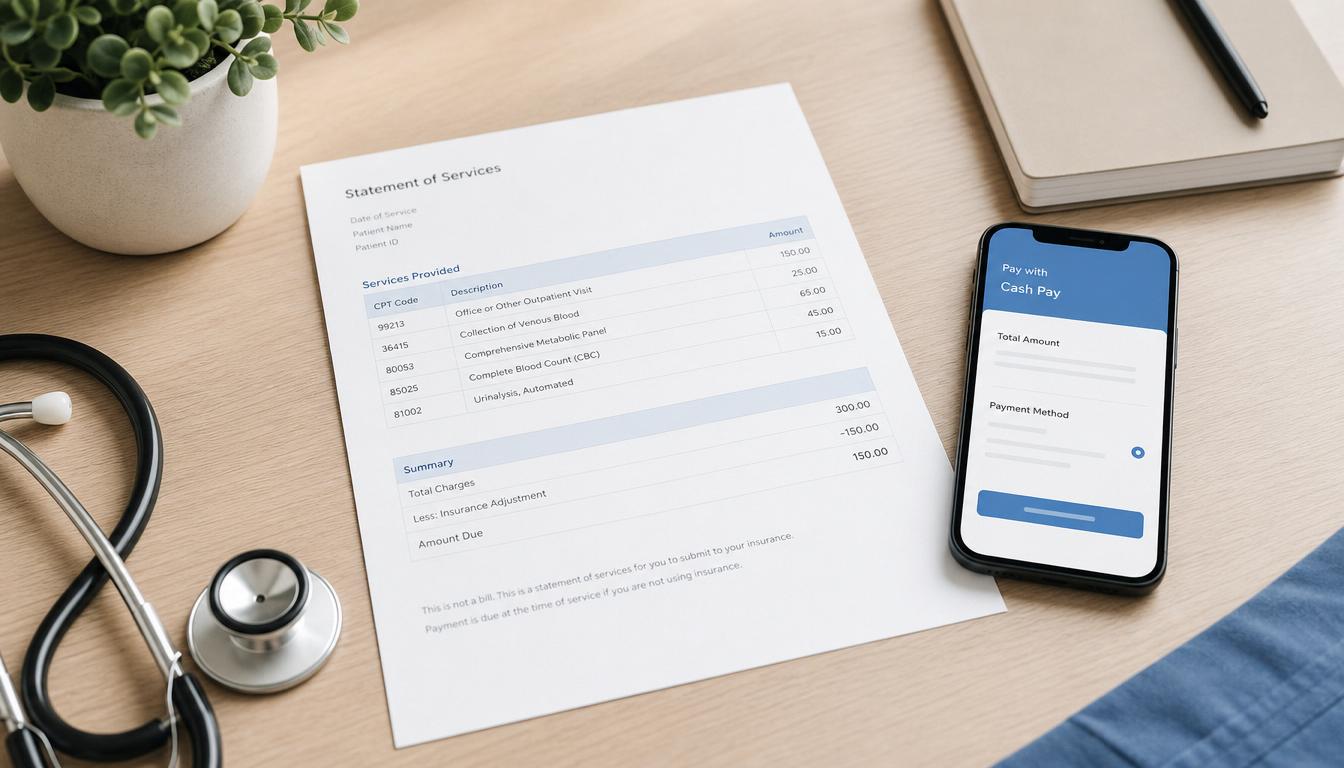
Cash-pay, direct-pay, and hybrid practices are reshaping how patients access care. But going outside traditional insurance billing does not mean going outside documentation. The superbill is the bridge: an itemized receipt that lets patients use their HSA or FSA funds, file out-of-network claims, or simply prove a qualified medical expense to the IRS.
A clean superbill is also a compliance asset. It documents what was done, why it was done, and who did it. That is why it still matters for any clinical or wellness practice that collects payment at the point of care.
What is a superbill?
A superbill is an itemized document given to a patient after a visit. The practice does not submit it to a payer. Instead, the patient uses it for one of three purposes:
- HSA record-keeping. The patient keeps it as proof of a qualified medical expense in case of an IRS inquiry.
- FSA reimbursement. The patient submits it to their FSA administrator to substantiate a charge or request reimbursement.
- Out-of-network insurance claim. The patient submits it to their own insurer as an out-of-network (OON) claim.
For the HSA use case, the document can be as simple as an itemized receipt showing provider, patient, date, service, and amount. For FSA and OON reimbursement, the requirements become more detailed.
Why cash-pay practices still need a superbill
Even if you never file an insurance claim, a superbill helps you:
- Unlock patient spending vehicles. HSA and FSA dollars are common in cash-pay and concierge models. Patients will ask for a receipt they can submit.
- Capture out-of-network revenue. Many patients have PPO plans with OON benefits. A complete superbill lets them file for partial reimbursement and lowers their net cost of care.
- Build credibility. A professional, coded document signals that your practice is organized, legitimate, and ready for an audit.
- Create a defensible paper trail. The superbill supports the clinical record and can help demonstrate coding accuracy if a payer or regulator asks questions.
What goes on a superbill?
A complete superbill usually includes the following elements. The exact requirements depend on how the patient will use it.
| Element | When it matters | Where to find it |
|---|---|---|
| Practice name, address, phone | All uses | Business licensing and formation documents |
| Date of service | All uses | Each service line |
| CPT / HCPCS codes | FSA (sometimes) and OON claims | AMA CPT; many practices use a defined short list for common services |
| ICD-10 diagnosis codes | FSA (sometimes) and OON claims | CDC ICD-10 lookup; must match the chart |
| Diagnosis pointers | OON claims | Link each service line to the supporting diagnosis |
| NPI (Type 1 or Type 2) | OON claims | NPI Registry |
| Taxonomy code | OON claims | NUCC lookup |
| Place of service code | OON claims | CMS place-of-service codes |
| Charge, amount paid, balance | All uses | Must reconcile per line |
Here is a simple summary of requirements by use case:
| Use case | Codes needed | Letter of Medical Necessity | Who submits |
|---|---|---|---|
| HSA record | Optional | No | Patient keeps it |
| FSA reimbursement | Sometimes required | Sometimes, for non-medical-on-their-face services | Patient to FSA admin |
| Out-of-network insurance | Required | Sometimes | Patient to insurer |
Common coding mistakes that sink reimbursement
Out-of-network claims are denied for the same reasons in-network claims are denied. The most common issues we see in cash-pay audits are:
- Missing diagnosis pointers. Each service line must point to at least one diagnosis that supports it.
- Unsupported codes. Choosing a diagnosis or a higher-level visit code that is not documented in the chart is upcoding, and it is treated as fraud regardless of who bills.
- Wrong place-of-service code. Telehealth, home visits, and office visits all carry different codes.
- Modifier confusion. Common modifiers include 25 (separate evaluation), 95 (telehealth), and 59 (distinct procedure). Many visits use none.
- NPI mismatch. Billing under the wrong individual or group NPI is a fast path to denial.
How Camino helps
A superbill is only one piece of a compliant cash-pay workflow. The rest includes the right corporate structure, provider contracts, coding templates, and documentation standards. Camino Strategy Group works with digital health startups, private practices, and clinic operators to:
- Design PC/MSO and other ownership structures that match your state and specialty.
- Build coding and documentation templates that are accurate, defensible, and easy for your staff to follow.
- Review vendor contracts, credentialing workflows, and billing compliance before an audit or payer review.
- Create recurring compliance calendars and oversight programs that keep the paper trail current.
If you are launching or scaling a cash-pay, hybrid, or telehealth practice, the paperwork should support the business, not slow it down. Let us audit your workflow and turn it into a system that holds up.
Ready to get your superbill and compliance workflow right? Schedule a call and we will map out what your specific practice needs to document, code, and scale.