
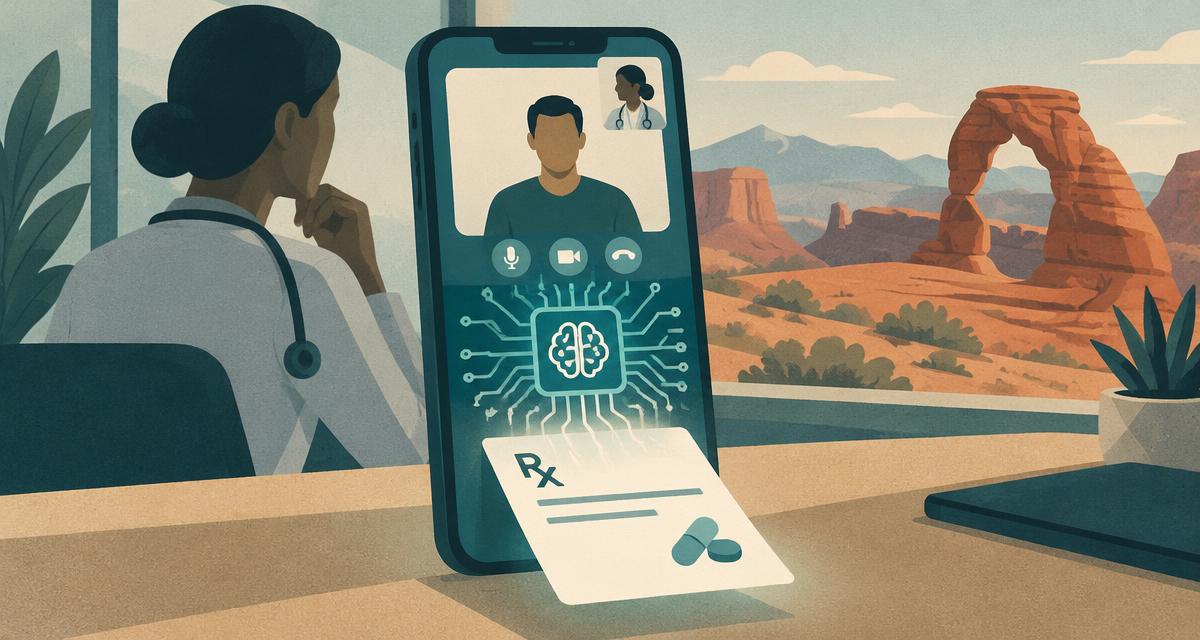
On October 5, 2026, Nolla Health announced that Utah has authorized its AI to issue first-time prescriptions for acne, which the company is calling the first approval of its kind in the country. Earlier this year Utah let Doctronic use AI to renew existing prescriptions, and that already drew serious pushback from physicians, but Nolla is a step further because the AI is now assessing the patient, choosing the treatment, and writing the first prescription.
What Utah approved
The pilot runs through Utah's Office of Artificial Intelligence Policy, which was created in 2024 and can temporarily waive certain state laws for companies in its regulatory sandbox. Under Nolla's agreement, the Division of Professional Licensing agreed not to bring enforcement for unlicensed or unprofessional conduct, or under Utah's telehealth requirements, when the AI writes these prescriptions (Unite.AI).
Here is how it works, in plain terms:
- Who it covers: Utah adults 18 and older with mild to moderate acne, through the Nolla Derm app, at $4.99 a month plus the cost of medication (HLTH).
- How the AI decides: The patient answers a health questionnaire and takes a face scan from several angles, and the AI grades severity and picks from eight approved topical creams and gels (Entrepreneur).
- What is excluded: Oral medications, isotretinoin, severe acne, and patients with conditions like pregnancy or a weakened immune system are screened out and sent to a physician (Cybernews).
- How oversight works: Two Utah-licensed physicians approve every prescription for at least the first 100 patients. In the second stage, covering up to 500 patients over at least eight weeks, the AI sends the prescription first and physicians review it afterward (HLTH). After that, review drops to a monthly 10% sample plus every adverse event (pasqualepillitteri.it).
To be fair to Nolla, this is a narrow pilot, and the company says it met with the Utah Medical Board before launch and that the AI can only choose from physician-approved protocols (Medical Economics). The company also describes the acne app as the first in a planned suite of AI health products, which tells you acne is the starting point and not the ceiling.
Where we stand on AI in healthcare
We work with companies that use AI every single day, and we think it is an amazing tool. Where we land on this one is simple: we do not think taking physicians out of the loop is safe, we do not think it makes sense, and we do not think it is what patients actually want.
To be clear, this is not an anti-AI position. The companies we work with use it for intake, documentation, scheduling, patient education, chart prep, and operations, and when it is built well it gives clinicians time back and makes care easier to access. We would much rather see AI take the paperwork off a physician's plate than see a physician spend their evening on prior authorizations.
We are also not saying doctors are perfect, because they are not, and anyone who has worked in this industry knows that. Our view is that AI and physicians go hand in hand, where the technology handles speed and pattern recognition and the clinician handles judgment, context, and accountability. The problem with this pilot is not that AI is involved, it is that the design moves the physician from making the decision to reviewing a sample of decisions after the fact.
Why oversight that scales back is the concern
After years spent auditing hospital systems and health plans from the regulatory side, one lesson stands out: oversight is only as good as the moment it happens. A physician approving a prescription before it goes out is oversight, while a physician reviewing a 10% monthly sample after patients already have the medication is a quality audit, and those are two very different things for the patient on the other end.
And the numbers behind that shift are small. Physicians approve prescriptions up front for roughly the first 100 patients, then review the next 500 or so after the medication has already gone out, and once the AI clears those stages, review drops to about 10% of charts a month (pasqualepillitteri.it). That means about 600 patients stand between a pilot and near-autonomous prescribing, and only around 100 of them ever had a physician sign off before treatment started. For an app the company says has more than 175,000 downloads across 44 states (Utah Business), a sample that size is not going to surface the rare reactions, the unusual presentations, or the patients who look like a textbook case and are not, and those are exactly the patients a 10% audit is most likely to miss.
Nolla says physicians agreed with the AI in roughly 96% of cases across 1,000 real treatments, and that disagreements were about a single dosage step within the same drug class (pasqualepillitteri.it). That is a strong number for a narrow use case, but it is also the company's own number, and agreement with a physician on the easy cases does not tell you much about the patients who do not fit neatly into a protocol, which is where clinical judgment actually matters.
The other piece we keep coming back to is accountability. In every structure we help build, there is a licensed clinician whose name is on the prescription and who answers to a medical board. Here the state has agreed not to enforce its own licensing and telehealth rules for the pilot, so when something goes wrong for a patient, it is not obvious who carries that responsibility, and a sandbox is not designed to produce the kind of evidence that would answer it.
Health is not one-size-fits-all
Working in this industry, it becomes clear how deeply personal care needs to be. The push to automate, to move faster, and to optimize every step is understandable, and we help companies do that every day, but health is not a one-size-fits-all product, and we are honestly not convinced it is something you can fully train a model on.
Acne is a good example of why. Nolla calls it well understood and low risk, and for many patients it is, but breakouts can also be tied to hormones, conditions like polycystic ovary syndrome, a new medication, birth control changes, stress, or the products someone is putting on their skin. A face scan and a short questionnaire can grade how acne looks, but they are not great at asking the follow-up question a good clinician asks when something does not add up, and that follow-up question is often where the real answer is.
There is also the person behind the skin. Acne affects how people feel about themselves, and a lot of patients come in wanting to be heard as much as they want a cream, which is something we see over and over in the practices we support.
Do patients need to keep getting prescribed?
The bigger concern with auto prescribing is the question nobody seems to be asking, which is whether people actually need to keep being prescribed these things. The agreement covers both first-time prescriptions and renewals (Unite.AI), and the product is a monthly subscription, so the default path for a patient is to stay on treatment and keep paying.
A good clinician is constantly asking whether a patient still needs a medication, whether the dose should come down, whether a different approach would work better, or whether the issue has resolved. Some acne treatments, especially topical antibiotics, are not meant to be used indefinitely on their own because of resistance concerns, and dermatology guidance generally favors pairing and limiting them. If any of the approved options fall into that category, the question of when to stop is just as important as the question of what to start.
When the system is built for fast output and a recurring subscription, the incentive leans toward continuing treatment, and we would want to see the pilot data report how often the AI recommended stopping or stepping down, not only how often it agreed with a physician on what to start.
What physicians and medical groups are saying
We are far from the only ones uneasy about this, and the physician community has been pretty vocal since the first Utah pilot.
- The AMA: American Medical Association CEO John Whyte told Bloomberg that AI tools "shouldn't autonomously be trying to practice medicine" (Entrepreneur).
- Utah physicians on the earlier pilot: The AMA and the Utah Academy of Family Physicians both formally objected to the Doctronic refill program, with the Academy saying Utah seemed willing to move ahead without the guardrails it needed (The Next Web).
- Utah's own medical board: The state's medical licensing board said it only found out about the Doctronic program when the launch hit the news, and it pushed to have it stopped (The Next Web). Nolla, to its credit, says it met with the board before launching.
- Even refills were controversial: Physicians argued that renewals alone still require judgment around dosing, side effects, and drug interactions, and Nolla's model goes further by diagnosing and choosing the first treatment (eMarketer).
- The federal picture is unsettled: A Health Affairs analysis pointed out that the FDA has stayed quiet on Utah's pilots and that a bill to let AI prescribe with state approval is still sitting in committee in Congress (Health Affairs).
Most of the physicians speaking out are not saying no to AI. They are saying AI that prescribes should be held to standards as rigorous as those for a human doctor, and we agree with that completely.
What this means if you are building in healthcare
If you are a founder or practice owner using AI, none of this means you should slow down on the technology. It means the companies that win long term will be the ones that use AI to make their clinicians faster and more present, not the ones that try to remove them, because patients can tell the difference and regulators eventually will too.
A Utah sandbox waiver also does not travel. Outside of this pilot, prescribing still requires a licensed clinician, your corporate practice of medicine structure still matters, and your medical director oversight still has to be real and documented. Build your AI workflows assuming a physician or other licensed prescriber stays in the decision, and treat Utah as an experiment to watch rather than a model to copy.
If you are figuring out where AI fits in your clinical workflow and how to keep it compliant, reach out and we can walk you through it.
References
- Nolla Health Launches Utah Pilot for AI-Powered Acne Prescriptions, HLTH, October 6, 2026
- Nolla Health Launches AI-Issued Initial Acne Prescriptions in Utah, Unite.AI
- From skin scan to prescription: AI acne prescribing launches in Utah, Medical Economics, October 5, 2026
- Utah's Breakout Star Is an AI App That Writes Acne Prescriptions, Entrepreneur, October 6, 2026
- AI can now prescribe acne medication in Utah, but not quite on its own, Cybernews
- Utah authorizes the first AI to prescribe drugs without a doctor, pasqualepillitteri.it
- AI takes on diagnosis and prescribing in the latest test of autonomous care, eMarketer
- Utah let AI prescribe medicine, The Next Web, April 8, 2026
- Utah let an AI renew prescriptions without a doctor, and its medical board wants it stopped, The Next Web
- AI Prescribing Medications In Utah: A Flawed Regulatory Playbook, Health Affairs Forefront
- Utah becomes first state to authorize AI to issue initial prescriptions, Utah Business, October 6, 2026
This post is for general informational purposes and reflects our professional opinion based on publicly available reporting as of October 10, 2026. It is not legal or medical advice.